Module 1
Agronomy & terroir
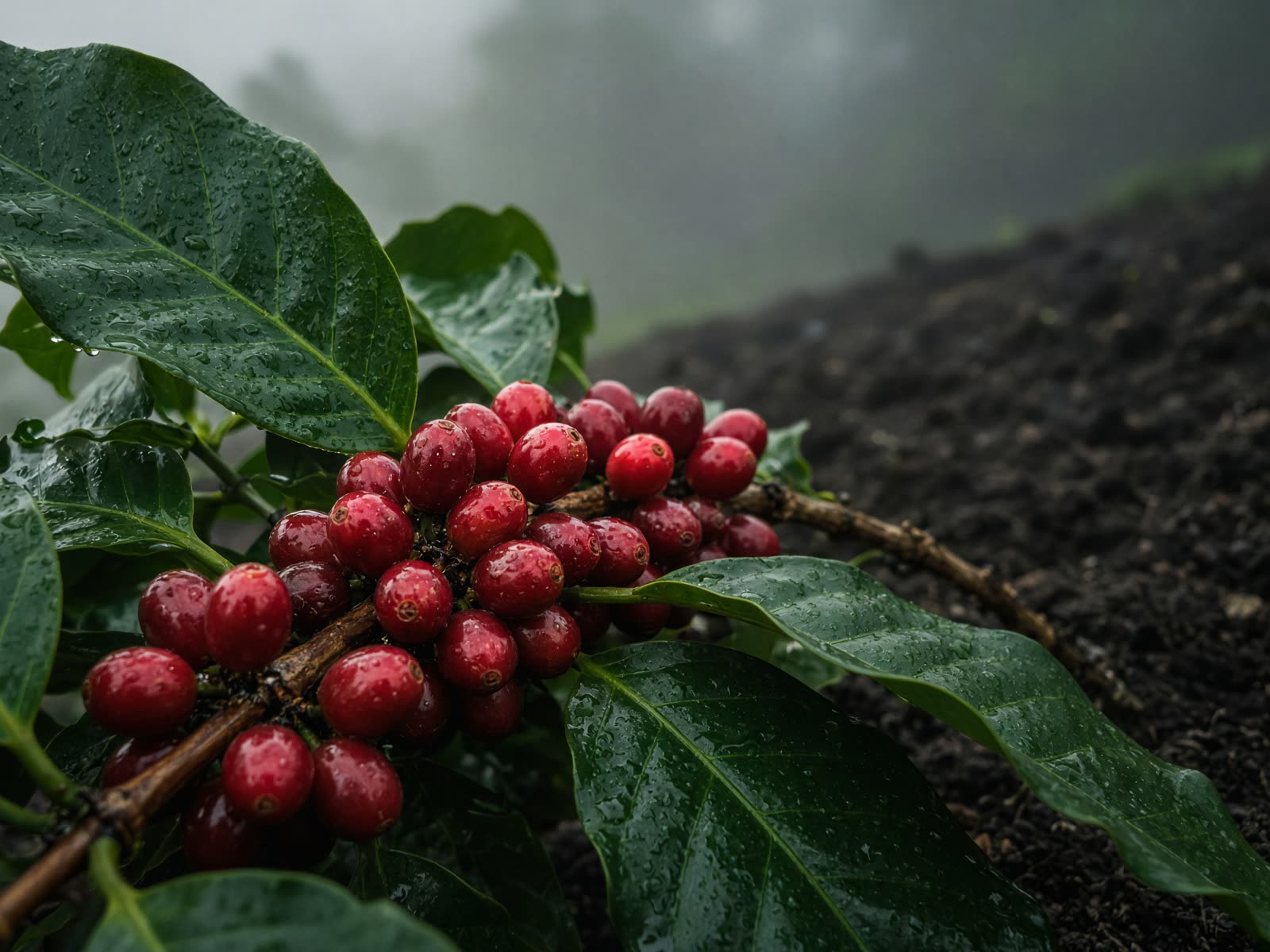
Coffee is a tropical fruit before it is a beverage. Species, altitude, and how the cherry is fermented decide more of the cup than any kettle trick.
Coffee Belt
Commercial coffee grows between the tropics of Cancer and Capricorn. Quality lives on high equatorial plateaus where nights are cool enough to keep citric and malic acids in the cherry.
Three species
Coffea arabica
Arabica
800–2200 m · Caffeine 1.2–1.5% · ~60%
Higher perceived acidity, floral and fruit esters, lower bitterness. The species of almost all specialty lots.
Tetraploid, self-pollinating. Frost- and disease-sensitive (CLR, CBD). Prefers 15–24 °C with a diurnal swing that slows cherry maturation and concentrates sugars.
Coffea canephora
Canephora / Robusta
0–800 m · Caffeine 2.2–2.7% · ~40%
Fuller body, lower acidity, cocoa and earth when well grown; rubbery or woody when stripped for volume. Fine Robustas now cup into the 80s.
Diploid, often cross-pollinated. Heat- and pest-tolerant. High chlorogenic acid and caffeine act as natural insecticides. Key in espresso blends for crema and structure.
Coffea liberica
Liberica
0–600 m · Caffeine 1.2–1.6% · <1%
Jackfruit, floral, woody smoke, and a lingering savory finish. Large, asymmetric beans. A distinct species, not a defected Arabica.
West African origin, now culturally central in the Philippines and Malaysia. Deep taproot, flood-tolerant, very large cherries.
Varietals
Typica
Yemen → Indonesia → Americas
Clean, sweet, tea-like, lemon and jasmine when washed at altitude.
The botanical parent of much of the New World. Low yield, excellent cup, high rust susceptibility. Bourbon is its sibling mutation lineage.
Bourbon
Réunion (Bourbon Island)
Rounder than Typica: caramel, red fruit, and a buttery body.
Typica mutation selected on Réunion. Red, yellow, and orange fruit-skin phenotypes. Parent of Caturra, Pacas, and Villa Sarchi.
Geisha / Gesha
Gesha, Ethiopia → Panama
Jasmine, bergamot, tropical fruit, tea-like structure. Extreme transparency.
Landed in Panama via Costa Rica (Boquete, 1960s) and exploded after Hacienda La Esmeralda 2004. High elevation and washed process usually show the floral peak.
Caturra
Brazil (Bourbon dwarf mutant)
Bright citric acidity, lighter body, clean when well processed.
Single-gene dwarfism (ct) from Bourbon. Higher yield per hectare, more rust-prone. Foundation of Catuai (Caturra × Mundo Novo).
SL28
Scott Agricultural Labs, Kenya
Blackcurrant, grapefruit, tomato-savory, phosphoric brightness.
Selected 1930s from drought-resistant Tanganyika drought-resistant / French Mission Typica material. The Kenyan flavor archetype.
SL34
Scott Agricultural Labs, Kenya
Deeper body than SL28, dark fruit, brown sugar, still citric.
Often planted with SL28. More rain-tolerant. Together they define washed Kenya AA/AB cup profiles.
Pacamara
El Salvador (Pacas × Maragogipe)
Floral, tropical, stone fruit, and a creamy body from the Maragogipe leaf.
Large-bean hybrid. Uneven ripening and low yield; spectacular when it hits. Famous in Santa Ana and Apaneca-Ilamatepec.
Ethiopia Heirloom
Ethiopian forests & gardens
Washed: jasmine, bergamot, peach. Natural: blueberry, strawberry, bergamot.
Not one cultivar — a genetic library. Garden, forest, and regional landraces (Kurume, Wolisho, Dega) plus JARC numbered selections (74110, 74112).
Terroir levers
Coffee Belt
Tropics between ~23.5° N and 23.5° S.
Stable day length and no hard frost. Quality, however, lives on the edges: equatorial highlands (Ethiopia, Kenya, Colombia) and volcanic mid-elevations (Central America, Indonesia).
Altitude & density
Higher, cooler, slower — denser beans, more sugar and acid.
Arabica cherries above ~1,500 m.a.s.l. often take 8–11 months to ripen. Slow starch-to-sugar conversion and thicker cell walls raise potential extraction complexity. Below ~1,200 m, body rises and acidity falls.
Volcanic soil
Potassium, phosphorus, drainage, mineral frame.
Andisols around the Pacific Ring of Fire (Guatemala Antigua, Sumatra Gayo, Hawaii Kona) hold water yet drain. Potassium supports sugar metabolism; the cup often reads as cocoa, stone fruit, and a long mineral finish — not 'tasting of lava'.
Diurnal swing
Warm days, cool nights lock in organic acids.
Night temperatures near 12–16 °C slow respiration so citric and malic acids are not burned off. Kenya's and Ethiopia's high plateaus are textbook; coastal lowlands flatten acidity.
Rainfall & harvest window
A dry harvest keeps cherries on the tree until sugar peaks.
1,500–2,500 mm/year with a defined dry season is the classic pattern. Unseasonal rain during harvest swells cherries, dilutes Brix, and invites fermentation defects (phenol, overripe).
Processing chemistry
Processing is controlled fermentation. Mucilage retention is the slider between washed clarity and natural ester-weight.
Washed / Wet process
Mucilage 0%Clarity, high-definition acidity, floral and citrus. The reference process for origin character.
Depulped, then mucilage is fermented in tanks (typically 12–36 h) so pectinases free the parchment. Washed, dried. Malic and citric acids remain relatively intact; esters of whole-cherry fermentation are minimized.
Parchment-only fermentation. pH typically drops from ~6.5 to ~4.5. Over-fermentation produces acetic and isovaleric notes (vinegar, sweaty).
Natural / Dry process
Mucilage 100%High sweetness, heavier body, blueberry–strawberry–tropical fruit, winey esters. Risk of ferment, phenol, or overripe if drying stalls.
Whole cherries dry on raised beds or patios 2–4 weeks. Yeast and bacteria in the intact fruit generate ethyl esters (ethyl butyrate, ethyl acetate) and higher alcohols. Sugars migrate inward.
Anaerobic pockets form inside the cherry. Even turning and a target water activity of ~0.55–0.65 aw is the quality gate.
White honey
Mucilage 20%Clean, sparkling acidity, light honey sweetness.
Most mucilage is washed off; a thin film remains. Fast dry, high oxygen. Closest honey to washed.
Minimal mucilage fermentation.
Yellow honey
Mucilage 50%Stone fruit, cane sugar, still transparent.
About half the mucilage retained. Color of the drying parchment shifts yellow as sugars oxidize.
Moderate aerobic mucilage fermentation.
Red honey
Mucilage 75%Syrupy body, red fruit, caramel.
Most mucilage kept; slower, shadier drying. More Maillard precursors survive into the green bean.
Longer mucilage ferment, still mostly aerobic.
Black honey
Mucilage 95%Heavy sweetness, dark fruit, lower clarity.
Nearly all mucilage retained, dried slowly under shade or plastic. Approaches natural chemistry with parchment still on.
High ferment risk — process of skilled mills only.
Anaerobic fermentation
Mucilage 70%Intense tropical fruit, yogurt/lactic, spices. Can read 'process-forward' if overdone.
Cherries or depulped parchment sealed in tanks; CO₂ or N₂ may be flushed. Lactobacillus and yeast dominate; lactic acid and tropical esters rise, acetic is kept in check by pH and time control (often 48–120 h, 15–20 °C).
Redox potential, Brix, and pH logging are the real craft.
Carbonic maceration
Mucilage 100%Candy fruit, floral lift, silky texture, low astringency.
Borrowed from Beaujolais: whole cherries under CO₂ so intracellular fermentation starts inside intact fruit before yeast on the skin takes over. Distinct from generic 'anaerobic'.
Requires true CO₂ saturation, not just a closed barrel.
Koji fermentation
Mucilage 50%Miso-savory, stone fruit, honeycomb, unusual umami.
Aspergillus oryzae inoculated on cherries or parchment. Koji enzymes (amylases, proteases) break starches and proteins into amino acids and reducing sugars — extra Maillard fuel.
Food-grade koji strain and humidity control; contamination is the failure mode.
Thermal shock
Mucilage 40%High clarity with a flash of tropical sweetness. Associated with some El Salvador and Colombian lots.
A hot wash (often ~50–60 °C) followed by a cold quench. Heat accelerates enzymatic mucilage breakdown; the quench arrests fermentation so acidity stays bright.
Time-at-temperature is measured in minutes, not days.
Wet-hulled (Giling Basah)
Mucilage 10%Low acidity, heavy body, cedar, cocoa, earth, herbal spice. The classic Mandheling/Lintong frame.
Sumatran method: parchment is hulled at ~30–35% moisture, then the naked bean dries. Exposes the embryo to oxidation and earth contact; chlorogenic profile and body shift.
Not a flavor defect when done on clean drying decks; muddy lots come from ground contact.