Module 2
Roast & thermodynamics
A roast profile is a heat history. The same green bean can be a jasmine filter or a smoky espresso depending on when you drop it.
Profile stages
Drying phase
Free water (~10–12% green moisture) is driven off. Endothermic. Charge temperature, airflow, and drum speed set the rate of rise (RoR) that the rest of the roast will inherit. Color stays green-to-yellow; hay and grain aromatics.
Steamed vegetable, wet paper, cereal. Not yet coffee.
Development time ratio
DTR = time after first crack ÷ total roast time. A number, not a religion — but it is the most useful single coordinate on a profile.
DTR
20.0%
Time of first crack (s)
Total roast time (s)
Filter window (Rao ~20–25%). Origin acids still articulate.
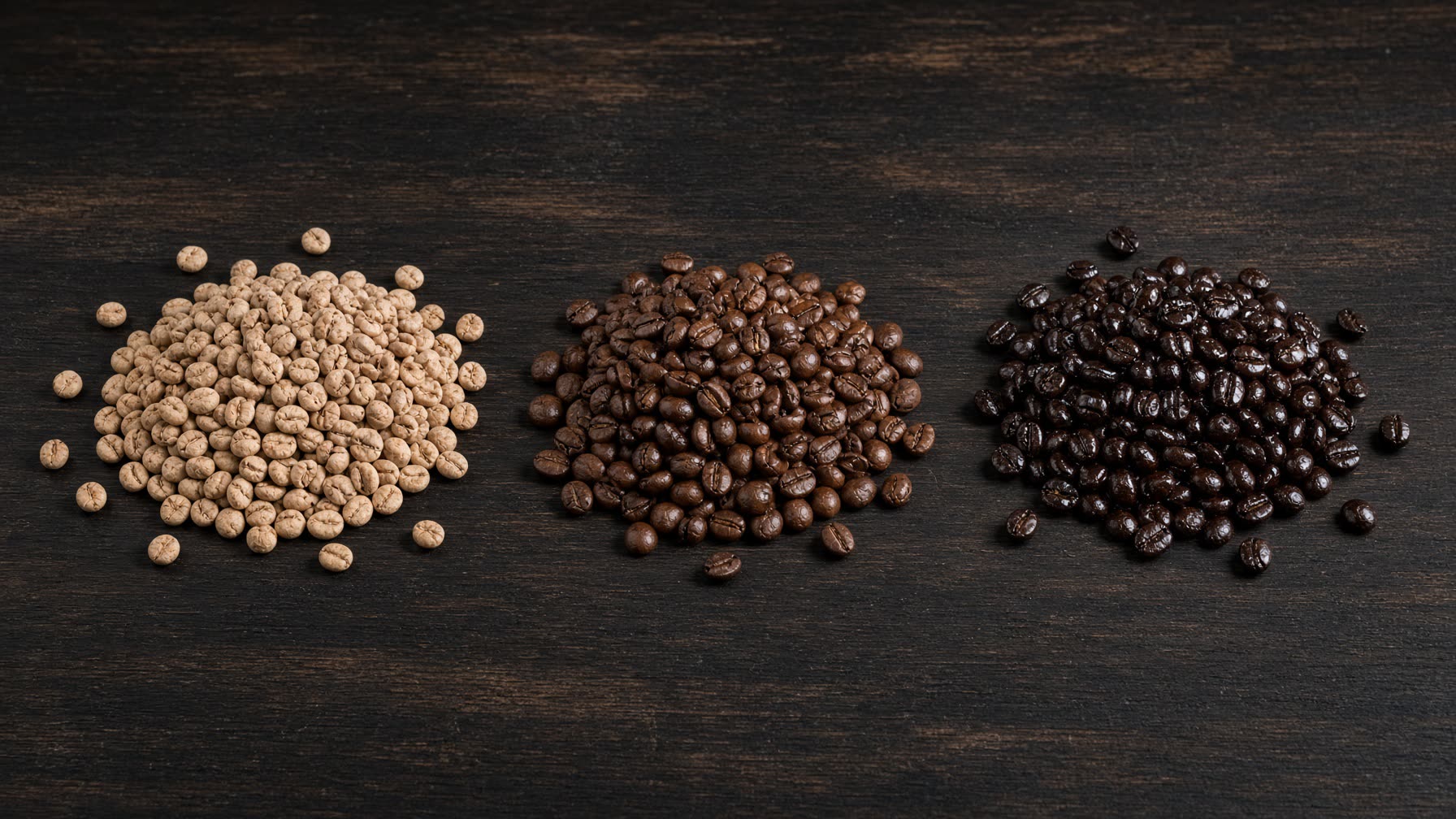
Roast level matrix
Relative intensity 0–10. Not a tasting score.
Cinnamon
196–205 °C · Agtron 80–95
Dropped at the start of first crack. Grassy risk, peak origin florals, tea body.
City
205–210 °C · Agtron 65–80
End of first crack. The modern specialty default for washed Ethiopians and Kenyans.
City+
210–219 °C · Agtron 55–65
Sweetness peak for many Centrals. Caramel and stone fruit, acids still articulate.
Full City
219–224 °C · Agtron 45–55
On the verge of second crack. Chocolate, heavier body, espresso-oriented.
Vienna
224–230 °C · Agtron 35–45
Into second crack. Surface oil begins. Bittersweet cocoa, spice, low origin.
French
230–240 °C · Agtron 25–35
Oily, smoky, low acidity. Classic dark espresso and café au lait roast.
Italian
240–250 °C · Agtron 15–25
Pyrolysis-dominant. Carbon, tobacco, thin if taken too far. Southern Italian tradition.
Chemical byproducts
Chlorogenic acids
Green bean (5–8% dry basis) → Caffeic + quinic acids
Degrade through the roast. Quinic acid is a primary bitterness/astringency driver in dark roasts; caffeic contributes phenolic bite.
Trigonelline
~1% of green Arabica → Niacin (B3) + pyridines
Significant degradation above ~230 °C. Residual trigonelline is bitter-sweet; pyridines read roasted and sometimes fishy if excessive.
Pyrazines
Maillard / Strecker → Nutty, roasted, cocoa notes
2,3,5-trimethylpyrazine and tetramethylpyrazine are cocoa/nut markers in the WCR lexicon.
Furans & aldehydes
Sugar caramelization → Furaneol, maltol, Strecker aldehydes
Furaneol (strawberry/caramel), 5-methylfurfural (maple), phenylacetaldehyde (honey). Light-medium roasts keep more of them.